AI Is Cutting These Tech Jobs in 2026 — and Creating These New Ones
AI is reshaping tech hiring in 2026 — eliminating junior dev and support roles while creating 1.3M+ new positions. Find out which jobs are at risk and which to target.

AI Is Cutting These Tech Jobs in 2026, and Creating These New Ones
The conversation has shifted. It's no longer "Will AI replace jobs?" It's "Which jobs, how fast, and what's replacing them?" In 2026, that question has a clearer and more urgent answer than it did a year ago.
Tech layoffs hit their highest single month in years in May 2026, and AI was the most-cited reason, according to outplacement firm Challenger, Gray & Christmas. AI accounted for 40% of all cuts announced in May, up from just 7% in January, and has already been cited in 87,714 cuts (22% of all 2026 layoffs), far surpassing the 54,836 attributed to AI across all of 2025.
But layoffs are only half the story. AI has simultaneously added more than 1.3 million new roles, including AI Engineer, Forward-Deployed Engineer, and Data Annotator, alongside over 600,000 AI-enabled data center jobs. LinkedIn calls this the "new-collar" era: a workforce that blends advanced technical skills with distinctly human strengths.
This article breaks down exactly which tech roles are being eliminated, which new ones are growing fast, and what you can do about it right now.
The state of tech hiring in 2026

More than 142,000 U.S. tech workers lost jobs in the first five months of 2026, a 33% increase over the same period in 2025. AI is now the most-cited reason for U.S. layoffs overall, accounting for 13% of job cuts in Q1 2026, up from just 0.6% in 2024.
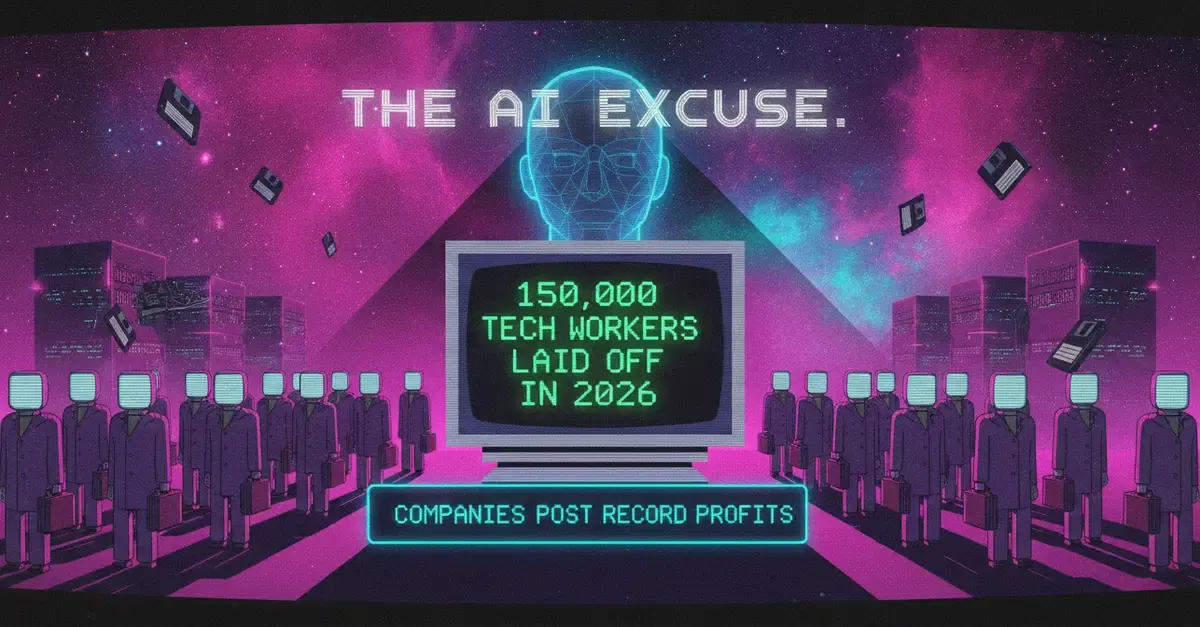
What makes this wave structurally different from the post-pandemic corrections of 2023 and 2024 is the type of displacement happening. Earlier waves were about reversing over-hiring. This one is about companies actively replacing human workflows with AI systems. The same organizations eliminating positions are reporting record profits and committing to $700 billion in AI infrastructure spending. This isn't austerity; it's reallocation.
The technology driving 2026 displacement isn't the copilot-style tools that assisted workers with isolated tasks in 2024 and 2025. It's agentic AI: autonomous systems capable of completing multi-step workflows (drafting, testing, reviewing, routing, and resolving) without human intervention. That distinction matters enormously for understanding which roles are truly at risk and which are being created.
For job seekers, the strategic implication is stark. The roles disappearing and the roles being born are separated not by seniority or salary, but by what kind of work they involve. Routine, process-following work is being automated. Judgment-heavy, system-shaping, and human-relational work is being amplified.
Tech roles being eliminated, and why

Understanding exactly which roles are being cut helps you evaluate your own exposure and decide where to redirect your energy.
- Entry-level software developers. Tasks like CRUD operations, basic testing, and boilerplate code generation are now largely automated. Stanford HAI's 2026 AI Index found that employment among 22-to-25-year-old software developers fell nearly 20% from its late 2022 peak by mid-2025. According to Indeed, software developer listings are down approximately 35% from pre-2020 levels and 70% from their 2022 peak, with entry-level postings dropping 60% between 2022 and 2024. At Google Cloud Next 2026, CEO Sundar Pichai stated that 75% of all new code at Google is now AI-generated and approved by engineers.
- Customer support representatives. Salesforce eliminated 4,000 customer support roles after deploying AI agents that now handle 50% of customer interactions. Industry-wide, AI chatbots and voice agents handle approximately 80% of Tier 1 support interactions at roughly 80% lower cost. The 2.9 million U.S. workers in this category face the most immediate near-term displacement risk of any occupational group.
- HR generalists and administrative staff. IBM's AskHR system handles 11.5 million employee interactions annually with minimal human oversight. IBM subsequently eliminated 8,000 HR roles citing automation. Routine administrative functions (benefits processing, basic employee queries, compliance documentation) are being automated at scale across the enterprise sector.
- Mid-level managers overseeing small teams. Google cut more than a third of the managers overseeing small teams, 35% fewer managers with fewer direct reports. Cloudflare eliminated about 20% of its workforce (roughly 1,100 people) while reporting its highest-ever quarterly revenue, with CEO Matthew Prince explicitly noting the cuts targeted "measurers": middle management, internal audit, and revenue recognition roles.
- Junior QA testers. Automated testing frameworks and AI-driven code review tools have sharply reduced the need for manual test writing and bug triaging at the entry level.
- Basic data analysts. Dashboard generation, SQL query writing, and standard reporting are now tasks most business intelligence AI tools handle automatically, squeezing out the generalist analyst who doesn't own interpretation or strategy.
Tech roles being created, and what they actually pay
The good news is real and substantial. AI is generating entirely new job categories at scale, and compensation in these roles runs well above market averages.
- AI/ML engineer. Designs, trains, and deploys machine learning models and AI systems. Demand has surged as every enterprise races to build proprietary AI capabilities.
- AI product manager. Translates business needs into AI system requirements and bridges engineering teams with stakeholders. Requires genuine understanding of model capabilities and limitations.
- Prompt engineer / AI interaction designer. Architects the instructions, workflows, and guardrails that govern how AI agents behave. Increasingly formalized as a dedicated discipline.
- Forward-deployed engineer. Embedded directly with enterprise clients to configure and customize AI solutions in production. Combines software engineering with consulting skills.
- AI infrastructure / MLOps engineer. Manages the pipelines, compute resources, and monitoring systems that keep AI models running reliably at scale.
- Data annotator / RLHF specialist. Labels, evaluates, and provides human feedback on AI outputs to improve model quality. For many people, it's the entry point into the AI ecosystem.
- AI safety and alignment researcher. Works on ensuring AI systems behave reliably and ethically. Growing rapidly as regulatory pressure intensifies globally.
- AI governance and compliance officer. Navigates the legal and regulatory environment around AI deployment, particularly in finance, healthcare, and government.
Realistic salary ranges for 2026's AI-era tech roles
The wage premium for AI fluency is significant and growing. Workers with AI expertise earned 56% more than peers without it in 2026, up from an 18% premium just two years earlier. Conversely, senior developers lacking AI fluency saw salaries drop 10% year over year.
| Role | Entry-level | Mid-level | Senior / lead |
|---|---|---|---|
| AI/ML engineer | $110,000, $140,000 | $150,000, $200,000 | $220,000, $350,000+ |
| AI product manager | $105,000, $130,000 | $145,000, $185,000 | $200,000, $280,000 |
| Prompt engineer | $80,000, $110,000 | $120,000, $160,000 | $170,000, $220,000 |
| Forward-deployed engineer | $115,000, $145,000 | $160,000, $210,000 | $230,000, $320,000 |
| MLOps / AI infrastructure eng. | $105,000, $135,000 | $150,000, $195,000 | $210,000, $300,000 |
| Data annotator / RLHF specialist | $45,000, $70,000 | $70,000, $100,000 | $100,000, $140,000 |
| AI governance and compliance | $90,000, $115,000 | $125,000, $165,000 | $175,000, $240,000 |
Remote roles in AI engineering command a modest 5, 10% premium over on-site equivalents due to global talent competition. On-site roles at major AI labs (OpenAI, Anthropic, Google DeepMind, Meta AI) carry significant equity components that can double or triple total compensation.
What employers actually require in 2026
Hard requirements checklist
- ☑ Proficiency in Python (non-negotiable for most AI/ML roles)
- ☑ Hands-on experience with at least one major ML framework (PyTorch, TensorFlow, or JAX)
- ☑ Familiarity with cloud AI services (AWS SageMaker, Google Vertex AI, Azure ML)
- ☑ Understanding of LLM architecture, fine-tuning, and RAG (Retrieval-Augmented Generation) pipelines
- ☑ For AI PM roles: product management experience plus the ability to read model evaluation metrics
- ☑ For governance roles: legal or policy background plus working knowledge of the EU AI Act, NIST AI RMF, or equivalent frameworks
- ☑ Relevant certifications: AWS Certified Machine Learning Specialty, Google Professional ML Engineer, DeepLearning.AI specializations, or Coursera's AI for Everyone (for non-technical pivots)
What employers prioritize beyond the resume
Technical credentials get your application through the door. But employers in AI-era tech are specifically looking for people who can operate effectively in ambiguity. The field moves fast enough that systems and frameworks change every few months. Hiring managers want candidates who learn in public (GitHub activity, published models, Kaggle rankings, blog posts explaining technical concepts), who communicate clearly across technical and non-technical audiences, and who show genuine intellectual curiosity about AI's limitations, not just its capabilities. Candidates who approach AI tools critically are increasingly valued, especially in safety, governance, and product roles.
Hiring trends reshaping tech in 2026
The structural forces reshaping tech hiring this year aren't temporary. They represent lasting changes to how the industry organizes work.
"Junior" no longer means "learning on the job." With AI handling boilerplate and routine code, companies have eliminated the apprenticeship model that used to exist for new engineers. Recent graduates are expected to contribute at a level that previously required two to three years of experience. This has made portfolio evidence (not credentials alone) the primary hiring signal for early-career candidates.
Headcount is decoupling from revenue. Cloudflare's record quarter alongside a 20% headcount reduction is one clear example of a new model: AI-augmented teams doing more with fewer people. Hiring will remain selective even as the industry grows. Companies aren't pausing AI investment; they're accelerating it. The $700 billion in AI infrastructure spending committed for 2026 is creating enormous demand for a relatively small number of highly specialized roles.
The "new-collar" workforce is real and growing. LinkedIn's framing of the new-collar era reflects an observable reality: many of the highest-demand AI roles don't require traditional four-year CS degrees. Bootcamp graduates, self-taught engineers with strong portfolios, and professionals pivoting from adjacent fields (statistics, linguistics, law, business analysis) are being hired into AI roles at scale. The credential that matters most is demonstrated competence, not the name of your institution.
Regulation is creating a new hiring category. The EU AI Act's enforcement mechanisms are now active, and the U.S. is advancing sector-specific AI regulation in healthcare and finance. This is generating sustained demand for AI governance, compliance, and ethics roles: positions that didn't meaningfully exist three years ago and that combine legal, technical, and policy expertise in ways no single discipline fully trained for.
Resume and interview tactics for AI-era tech roles
1. Lead with AI tool fluency, not just programming languages. Generic resume skills sections listing "Python, SQL, Java" are table stakes. Specify which AI tools, frameworks, and systems you've worked with, and quantify the outcome. "Reduced test cycle time by 40% using GitHub Copilot and automated testing pipelines" beats "proficient in AI tools" every time.
2. Build a visible portfolio before you apply. Hiring managers for AI roles routinely check GitHub profiles, Hugging Face repositories, and Kaggle profiles before reading resumes. A fine-tuned open-source model, a published notebook, or a documented AI project with real results will outweigh years of claimed experience.
3. Tailor your resume to the specific AI stack in the job posting. Companies are not looking for generalist AI knowledge; they're looking for experience with their tools. If the posting mentions LangChain, Pinecone, or Vertex AI, those words need to appear in your resume (accurately, and only if you've actually used them).
4. Prepare for technical interviews that include live AI tool use. Many AI-role interviews now include sessions where candidates use AI coding assistants in real time and are evaluated on how they prompt, verify, and iterate on the output, not just whether they can code from scratch. Practice this explicitly.
5. In interviews, demonstrate critical AI thinking. Interviewers at AI-forward companies are tired of candidates who say "I use AI for everything." Differentiate yourself by articulating when not to use AI, what current model limitations affect your work, and how you verify AI outputs. This signals senior-level judgment regardless of your years of experience.
6. For pivot candidates: lead with transferable domain expertise. If you're moving into AI governance from law, or into AI product from healthcare operations, frame your non-technical background as an asset. AI teams desperately need people who understand the domain where AI is being deployed, not just the models.
Is the AI-era tech industry right for you?
| Best fit if… | Harder fit if… |
|---|---|
| You enjoy continuous, rapid learning | You prefer stable, well-defined job functions |
| You're comfortable with ambiguity and changing tools | You need structured onboarding and long ramp-up time |
| You can demonstrate skills through projects, not just credentials | Your background is entirely credential-based with no portfolio |
| You're genuinely curious about how AI systems fail | You're mainly interested in using AI, not understanding it |
| You can communicate technical concepts to non-technical stakeholders | You prefer working purely in technical silos |
| You're self-directed and can navigate self-paced learning | You need a traditional apprenticeship model to develop skills |
If most of the "best fit" column describes you, the pivot is worth pursuing aggressively. If the "harder fit" column is your honest self-assessment, there are still opportunities, particularly in AI governance, compliance, and product management, that may suit your profile better than pure engineering tracks.
Your next steps: how to move forward now
The window to get ahead of this shift is open, but it's narrowing. Here's an ordered action plan you can start today:
Audit your current role's AI exposure. Honestly evaluate how much of your daily work involves tasks that agentic AI can now perform: routing, drafting, testing, reporting, scheduling. If the answer is "most of it," you need to move before the market moves you.
Pick one AI certification and complete it within 60 days. Start with DeepLearning.AI's AI for Everyone (non-technical) or their Machine Learning Specialization (technical), Google's Professional ML Engineer prep, or AWS's Machine Learning Specialty. These signal commitment and build vocabulary for interviews.
Build one portfolio project in the next 90 days. It doesn't need to be original research. A well-documented application of an existing model to a real problem in your industry is enough. Publish it on GitHub or Hugging Face with a clear README explaining your methodology and results.
Join communities where AI hiring actually happens. Relevant Discords (Hugging Face, EleutherAI, LAION), LinkedIn's AI-specific groups, and local AI meetups are where early hiring signals surface before job boards. Contribute; don't just lurk.
Target roles at the intersection of your domain expertise and AI. The highest-leverage move for most career-changers isn't to compete with CS graduates on pure ML engineering. It's to find AI roles in your existing sector (AI in healthcare, AI in legal, AI in finance) where your domain knowledge is a genuine differentiator.
Rewrite your resume to reflect AI fluency today. Even if you're not job searching yet, updating your resume to accurately reflect your current AI tool usage positions you ahead of most peers. For every role you list, add at least one bullet quantifying an AI-assisted outcome. That habit alone will separate your application from the majority of the field.
The disruption is real, the timeline is compressed, and the opportunity is significant. Workers who treat this moment as a reason to act (rather than wait and see) are the ones who will be shaping their own next chapter.
Editor's Picks
 News
News AI Layoffs 2026: Record Profits, Pink Slips & Jobs That Survive
Jul 20, 2026
 Industries
 AI & ML Engineer Jobs 2026: Salaries, Skills & How to Break In
Jul 20, 2026
 Skills
 AI Skills Non-Tech Workers Actually Need to Get Hired in 2026
Jul 20, 2026
 Job Search
 Hidden Job Market 2026: Land Roles Never Posted Online
Jul 20, 2026