PwC 2026 AI Jobs Barometer: Are You Safe or at Risk?
PwC's 2026 AI Jobs Barometer reveals a two-track labour market. Find out which roles are growing, which are shrinking, and what you should do right now.

What Happened: PwC Releases Its 2026 Global AI Jobs Barometer (June 2026)

On 15 June 2026, PwC published its 2026 Global AI Jobs Barometer from London, one of the most comprehensive analyses of AI's impact on the global workforce to date. The report covered more than one billion job advertisements across 27 countries and territories, combining large-scale labour market data, company financials, and occupational task analysis. The headline conclusion is blunt: AI is not creating one labour market. It is creating two.
What this means if you're job hunting right now
The Barometer's central finding should change how every job seeker thinks about their career in 2026. PwC identifies a "two-track" global labour market that is rapidly splitting workers into two camps.
The first track covers "professionalised" roles: jobs where AI automates routine tasks so that human judgement, creativity, and expertise become more important, not less. Think radiologists interpreting complex scans with AI assistance, or recruiters making nuanced hiring decisions while AI surfaces the candidates. These roles are growing faster, paying more, and gaining prestige.
The second track covers "democratised" roles: jobs where AI lowers the barrier to entry so dramatically that the specialist knowledge the role once required is now partially or fully handled by a tool. IT service managers and medical secretaries are cited as examples. These roles are not disappearing overnight, but wage growth is slower and long-term demand is softer.
The question every job seeker needs to answer is simple: which track is your current or target role on?
Key numbers and facts at a glance
- Professionalised roles are growing twice as fast as democratised roles, with 42% faster wage growth since 2021 (37% salary growth vs. 26%).
- The average AI skills wage premium reached 62% in the latest data, up from 57% the prior year, and in some consumer markets sectors it exceeds 100%.
- AI specialist job postings rose 68.9% from 2024 to 2025, while total job postings grew just 8.6%, meaning AI-related roles grew roughly eight times faster than the broader market.
- The most AI-exposed companies grew headcount 52% relative to a 2018 baseline, versus 36% for less AI-exposed firms. Companies using AI are hiring more, not less.
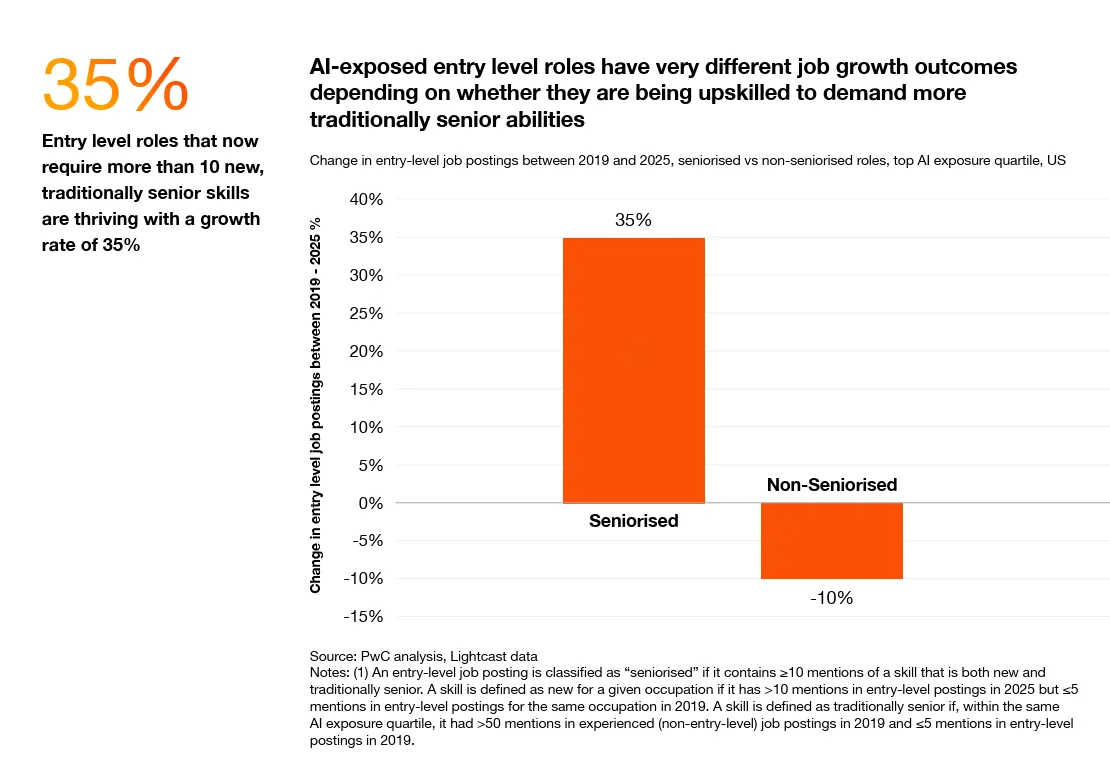
- Entry-level roles in highly AI-exposed occupations are 7x more likely to require senior-level skills like strategic decision-making and stakeholder management. PwC calls this "seniorisation".
- Skills in the most AI-exposed jobs are changing more than twice as fast as in the least exposed, a gap that grew 75% compared to the previous year.
- Tech, Media and Telecoms (TMT) leads all sectors, with AI specialist postings at 11.4% of all job ads in 2025, followed by Professional Services (5.6%) and Financial Services (5.4%).
Which workers and job seekers feel this first
Not all workers face equal exposure to the two-track divide. Here is how the impact breaks down.
Entry-level and early-career candidates face the sharpest disruption. The "seniorisation" trend means 52% of new skills appearing in entry-level postings in highly AI-exposed occupations are skills historically associated with experienced workers, compared to just 7% in low-AI-exposure roles. The routine, foundational tasks that once served as an on-ramp into careers are being automated away, raising the bar for first jobs.
Mid-career professionals in democratised roles, particularly those in IT support, administrative, and generalist back-office functions, face wage stagnation pressure even if their jobs persist in the near term. The Barometer's data suggests the earnings gap between professionalised and democratised workers will keep widening.
Workers with demonstrable AI skills are in the strongest position regardless of industry. The 62% wage premium is not sector-specific. It appears across professional services, financial services, consumer markets, and TMT.
Sector-specific workers will find that TMT professionals are at the centre of change, but the highest wage premiums are appearing in consumer markets, suggesting retail, FMCG, and hospitality workers who build AI skills may be sitting on an underappreciated earnings opportunity.
What employers and recruiters are doing right now
The report's employer-side findings are arguably its most surprising, and the most important for job seekers to absorb. The dominant narrative that AI kills jobs is, at least at the macro level, not what the data shows.
The most AI-exposed companies globally grew headcount 52% above their 2018 baseline, outpacing less AI-exposed firms by 16 percentage points. These companies are also paying more: wage growth of 24% vs. 17% for firms less positioned to use AI. A clear "superstar company" effect is emerging, with the top 20% of most AI-exposed companies achieving labour productivity growth of 163% relative to 2018, nearly five times higher than the broader AI-exposed cohort.
In practical terms, employers leaning into AI are expanding their teams, not contracting them, but the shape of those teams is changing fast. Recruiters are actively seeking candidates who can work alongside AI tools, demonstrate judgement in AI-augmented workflows, and bring human capabilities (empathy, leadership, creativity) that tools cannot replicate. New tasks added to AI-exposed roles are 2.5 times more likely to rely on exactly these human skills.
What you should do this week
The Barometer is not just a data exercise. It is a career planning document. Here are six concrete steps to act on right now.
Audit your current role against the two-track framework. Search your job title plus "AI automation" and read recent industry analysis. Determine whether your role is trending toward professionalisation or democratisation. That single classification should inform every career decision you make this year.
Add a visible AI skills layer to your resume immediately. With a 62% wage premium on the line, listing specific AI tools you use is no longer optional, even at a basic level. Be precise: name the tools, the tasks you use them for, and the output or time saving achieved.
Target roles at the most AI-exposed companies. The headcount and wage data are clear. These employers are growing. Filter your job search toward TMT, Professional Services, and Financial Services firms that are publicly investing in AI capabilities.
Prepare for "seniorised" entry-level interviews. If you are an early-career candidate, expect questions about strategic thinking, stakeholder communication, and decision-making frameworks, not just technical task execution. Prepare STAR-format answers that demonstrate judgement, not just competence.
Build one AI skill this month, not next quarter. AI specialist postings grew nearly nine times faster than the overall market last year. Even a single verified certification in a mainstream AI tool (Copilot, ChatGPT API, Gemini for Workspace) closes part of the wage gap. Enrol this week, not after your next performance review.
If you are in a democratised role, do not wait. The 42% wage growth gap between professionalised and democratised roles will compound over time. Start identifying adjacent professionalised roles in your field and map the skills bridge now, while you still have stable employment to fund the transition.
What to watch next
PwC's Barometer is released annually, so the 2027 edition will capture the full-year impact of 2026's AI adoption acceleration, particularly as frontier AI models become embedded in standard enterprise software. Watch for Q3 2026 labour market data from the BLS, ONS, and Eurostat, which will show whether the two-track divergence is appearing in official wage and employment statistics. Job Guide HQ will continue covering AI's impact on hiring, skills, and salaries as new data arrives. Bookmark this page and check back as the story develops.
"The average wage premium for workers with AI skills hit 62% and in some sectors, it exceeds 100%.", PwC 2026 Global AI Jobs Barometer
Editor's Picks
 News
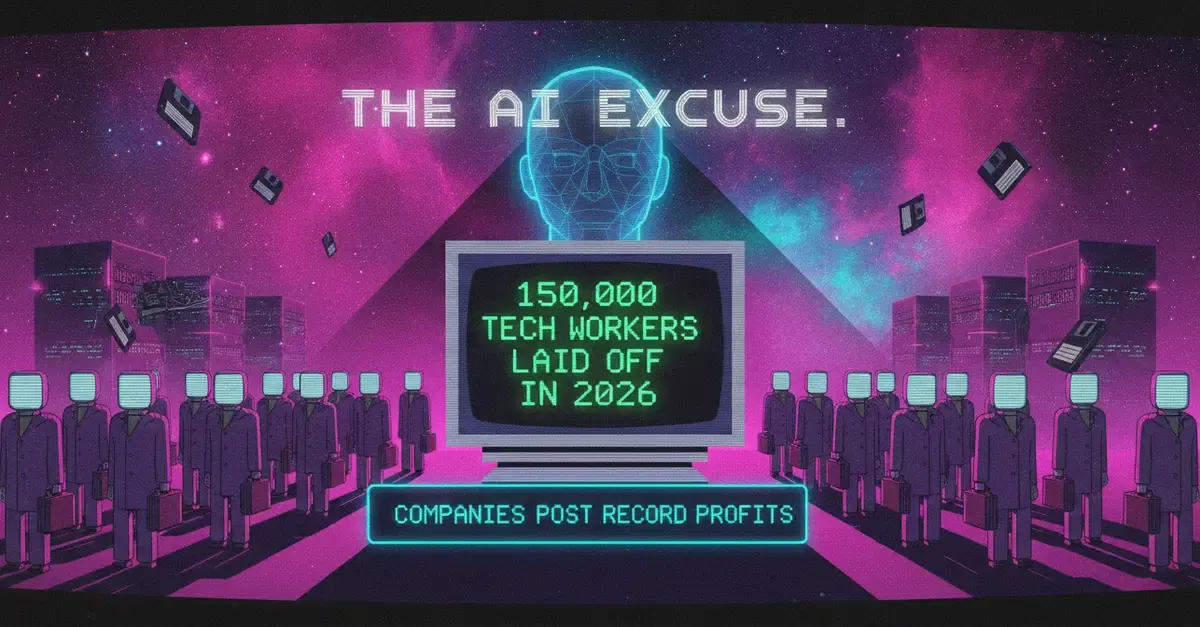
News AI Layoffs 2026: Record Profits, Pink Slips & Jobs That Survive
Jul 20, 2026
 Industries
 AI & ML Engineer Jobs 2026: Salaries, Skills & How to Break In
Jul 20, 2026
 Skills
 AI Skills Non-Tech Workers Actually Need to Get Hired in 2026
Jul 20, 2026
 Job Search
 Hidden Job Market 2026: Land Roles Never Posted Online
Jul 20, 2026