Weak Ties Win: Find Your 2026 Job Through Forgotten Contacts
Discover how weak ties — casual acquaintances you've forgotten — are your most powerful job search tool in 2026. Science-backed tactics to reconnect and get hired.
Weak Ties Win: Find Your 2026 Job Through Forgotten Contacts
You've refreshed your resume, applied to dozens of roles on LinkedIn and Indeed, and heard almost nothing back. Meanwhile, someone you barely know just landed a role at a company you'd love to work for, through a conversation at a conference three years ago. This isn't luck. It's a 50-year-old social science principle playing out in real time, and most job seekers are ignoring it entirely. This article is for anyone whose job search has stalled on the public boards and wants a concrete, step-by-step way to tap the single most overlooked source of job leads in 2026: weak ties.
Why weak ties matter more than ever in 2026
The job market in 2026 runs on a brutal paradox: open roles exist, but the front door is nearly impossible to walk through. A public job posting now attracts an average of 118 applicants per role, with some corporate positions pulling 250 or more. AI-powered applicant tracking systems screen out the majority before any human reads them. The odds of a cold application turning into an interview are worse than they've ever been.
What actually changes the game is where jobs live. Research consistently shows that up to 80% of roles are filled without ever being publicly posted, through internal promotions, employee referrals, direct personal contacts, and professional network conversations that happen before a job description is even written. A 2025 LinkedIn workforce report found that 85% of jobs are filled through networking in some form.
The economics make this inevitable. Hiring through job boards costs employers an average of $4,000 to $7,000 per hire. An employee referral costs $1,000 to $3,000 and fills the role in 29 days versus 39 days for a publicly posted position. Employers are rationally motivated to hire through people they already trust, which means your job search needs to be happening in those same channels. Weak ties are your ticket in.
The science of weak ties: why your forgotten contacts are gold

In the late 1960s, sociologist Mark Granovetter surveyed 282 professionals who had recently changed jobs and uncovered something genuinely counterintuitive. Most people assumed their close friends and family (their strong ties) would be the best source of job leads. The data said the opposite.
- Only 16.7% found their job via a contact they saw "often" (a strong tie)
- 55.6% found their job through someone they saw "occasionally"
- 27.8% found their job through someone they saw "rarely"
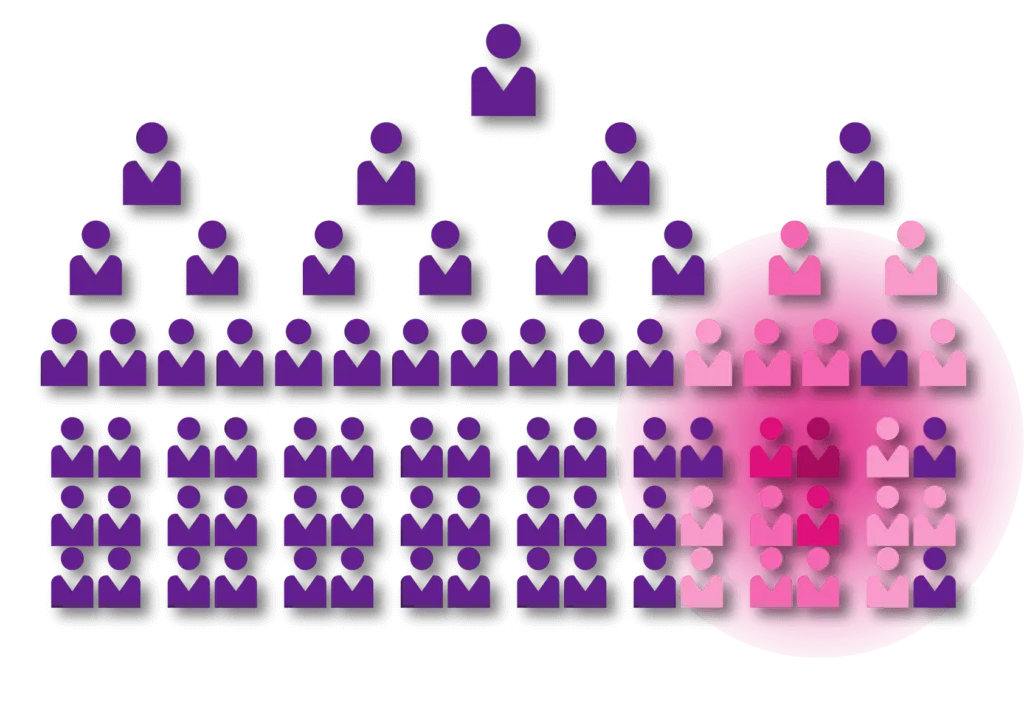
The pattern was clear: casual acquaintances, weak ties, were dramatically more useful for job hunting than close friends. The reason is structural. Your close friends largely know the same people you do and move in the same circles. Your weak ties (the former colleague you worked with briefly, the person you met at a panel, the university classmate you haven't spoken to in four years) exist in entirely different networks. They have access to information, opportunities, and connections you simply don't.
Then, in 2022, researchers from MIT, Harvard, Stanford, and LinkedIn ran the largest experimental test of Granovetter's theory ever conducted: 20 million users, 2 billion new connections, and 600,000 job changes tracked over five years, published in the journal Science. By randomizing LinkedIn's "People You May Know" algorithm to favor either stronger or weaker ties for different user groups, they were able to isolate the causal effect on job mobility.
The result was unambiguous. Connections with whom users shared only 10 mutual contacts were far more productive for finding jobs than stronger ties with 20+ mutual connections. The 50-year-old theory wasn't a pre-digital relic. It's a fundamental principle that holds true on the world's largest professional network. Your forgotten contacts aren't just warm leads. They're your best leads.
How to activate your weak ties: a step-by-step process
Step 1: Map your forgotten network
Before you reach out to anyone, spend 30 to 45 minutes doing a deliberate network audit. Open LinkedIn and scroll through your connections list (not your feed, your actual connections list). Export it as a CSV via Settings > Data Privacy > Get a copy of your data. Also check:
- Your email sent folder from the last 3 to 5 years
- Your phone contacts
- Old conference badges, business cards, or event app connections
- Former colleagues from jobs you held 3 to 8 years ago
- University or program alumni directories
- Dormant group chats (Slack workspaces, WhatsApp groups from past projects)
As you scan, flag anyone who works in an industry or function adjacent to your target role, not identical to it, adjacent. That's where the bridging value lives.
Step 2: Categorize by potential, not closeness
Sort your flagged contacts into three buckets:
| Bucket | Description | Priority |
|---|---|---|
| Industry Adjacent | Works near your target field or company type | High |
| Role Adjacent | Does something related to what you want to do | High |
| Connector Types | Naturally well-networked (recruiters, consultants, VCs, journalists, community organizers) | Very High |
| Former Colleagues | People you worked well with 3+ years ago | Medium-High |
| Alumni Contacts | Shared school or program, limited interaction | Medium |
Don't prioritize by how well you know them. Prioritize by how different their world is from yours while still being relevant to your target.
Step 3: Write a reactivation message that doesn't ask for a job
This is where most people fail. They reach out after years of silence and immediately ask for a favor. It reads as transactional and creates friction. Instead, use a two-beat structure: genuine context (why you're reaching out now) plus a low-stakes, specific ask.
Template A: Former colleague
"Hi [Name], I was thinking about [specific project or thing you worked on together] the other day, and I realized I hadn't been in touch in way too long. I'd genuinely love to hear what you've been up to. I'm in the middle of exploring some new directions career-wise and would love to catch up, even just for 20 minutes over coffee or a quick call. No agenda, I'm just trying to reconnect with people I respect. Are you open to it?"
Template B: Alumni or conference contact
"Hi [Name], we met at [event/context] back in [year] and I've been following your work at [company] since then, [specific thing they did or wrote]. I'm currently exploring opportunities in [field/space] and I'd love to pick your brain briefly on how the field looks from your vantage point. Would a 15-minute call work sometime in the next few weeks?"
Template C: LinkedIn reconnection with no specific memory
"Hi [Name], we're connected on LinkedIn and I realize I've never actually properly reached out. I've been reading more about [topic relevant to their work] and your background in [area] caught my attention. I'm navigating a career transition into [space] and would love to get your perspective. Would a brief call be something you'd be open to?"
Key rules: keep it under 150 words, reference something specific, make the ask low-stakes and time-bounded, and never use the words "job opening," "hiring," or "referral" in the first message.
Step 4: Run the conversation for information, not opportunity
When the call or coffee happens, resist the urge to pitch yourself. Ask questions that give them a chance to share what they know:
- "What's the hiring environment like at your company right now?"
- "What skills are you seeing become more valued in [field]?"
- "Are there any people or communities you'd recommend I connect with?"
- "If you were making a move in this space, where would you look?"
At the end, ask one warm handoff question: "Is there anyone you think I should talk to?" This is how weak tie chains extend. One connection leads to another, and that second-degree contact is often where the actual job lead lives.
Step 5: Follow up and stay in orbit
After every conversation, send a thank-you within 24 hours and include one specific reference to what you discussed. Then, within the next 2 to 4 weeks, send a lightweight update: an article relevant to their work, a note that you followed up with someone they referred you to, or a quick update on your search. The goal is to move from "someone I once talked to" to "someone I'm aware of," which is the exact definition of an active weak tie.
Mistakes that kill your weak tie strategy
1. Leading with the ask. A cold reconnection message that immediately requests a referral or asks about openings will get ignored. Reconnect first, ask second, ideally in a separate conversation.
2. Only targeting people you're comfortable with. Comfortable usually means strong ties. The whole point is to push toward the unfamiliar edge of your network. If reaching out feels slightly awkward, you're probably in the right territory.
3. Sending generic messages. "I wanted to reconnect and see if you know of any opportunities" is not a weak tie activation strategy. It's a spam template. Every outreach message should contain at least one specific, genuine detail.
4. Giving up after one message. Most people miss the first message or mean to reply and forget. One follow-up, sent 5 to 7 days later, is perfectly appropriate and noticeably increases your response rate.
5. Ignoring the second-degree referral. When someone suggests a person you should talk to, treat that introduction as your highest-priority lead. This is how the hidden job market surfaces: through a chain of two or three weak tie conversations, not one.
6. Not tracking your outreach. Without a simple system, you'll lose track of who you've contacted, what they said, and when to follow up. Use a spreadsheet or a free tool like Notion or Airtable with columns for Name, Platform, Date Contacted, Response, Follow-up Due, and Next Step.
Tools and templates to organize your weak tie campaign
| Tool | Use | Cost |
|---|---|---|
| LinkedIn (exported CSV) | Full contact audit | Free |
| Notion or Airtable | Outreach tracker | Free tier available |
| Google Sheets | Simple contact pipeline | Free |
| Hunter.io | Find professional email addresses | Free tier (25/month) |
| Calendly | Frictionless scheduling for calls | Free tier available |
| Apollo.io | Contact data for alumni/industry outreach | Free tier available |
Outreach volume benchmark: Aim for 5 to 8 new weak tie reactivations per week. At that pace, you'll have 20 to 30 conversations active within a month, enough to surface multiple leads from second-degree connections.
Adapting this strategy to your situation
If you're changing careers
Your weak ties in your current industry may not seem immediately useful, but they often know people who've made similar pivots. In your outreach, frame your transition clearly and specifically: "I'm moving from [X] into [Y]" rather than vague language like "exploring new directions." People can only help you if they understand precisely where you're headed.
If you're targeting remote or international roles
Geographic weak ties matter less than functional or industry ones. Prioritize contacts who work for distributed or globally-headquartered companies, or who are active in online-first communities (Slack groups, Discord servers, niche forums). Mention explicitly that you're open to fully remote roles. This signals immediately that geography isn't a constraint and expands who they can refer you to.
If you're early-career or have a small network
Your network is bigger than you think. Consider: high school or university classmates now 2 to 5 years into careers, professors or advisors, past internship supervisors, people you've interacted with in LinkedIn comments or niche communities, and even alumni from extracurricular groups. Alumni networks are particularly strong for entry-level seekers because the shared identity creates an automatic reason to help.
Your weak tie action checklist
- Export your LinkedIn connections as a CSV and do a full network audit
- Scan your email sent folder, phone contacts, and old event apps for forgotten contacts
- Flag 20 to 30 contacts who are industry or role adjacent, not your closest friends
- Prioritize connector-type contacts (recruiters, consultants, community organizers)
- Write personalized, specific reactivation messages under 150 words, no job ask in the first message
- Run each conversation as an information-gathering session, not a pitch
- End every call with: "Is there anyone you think I should talk to?"
- Follow up within 24 hours with a specific thank-you
- Re-engage with a lightweight touchpoint 2 to 4 weeks later
- Track all outreach in a spreadsheet or tool (Notion, Airtable, Google Sheets)
- Target 5 to 8 new reactivations per week
- Treat every second-degree referral as a top-priority lead
Frequently asked questions
How is a weak tie different from a strong tie? A strong tie is someone you interact with regularly and are emotionally close to: a best friend, a current colleague, a family member. A weak tie is a casual acquaintance, someone you've worked with briefly, met at an event, or connected with online but rarely speak to. Mark Granovetter's research, confirmed by the massive 2022 LinkedIn study, shows that weak ties are consistently more useful for finding jobs because they move in different social circles and have access to information and opportunities you don't.
What if I feel embarrassed reconnecting after years of silence? Most people are far less bothered by this than you'd expect. People are generally flattered to be asked for their perspective or expertise. The key is being honest and specific: acknowledge the gap briefly if needed ("I know it's been a while") and immediately pivot to something genuine. An awkward reconnection is infinitely more productive than no reconnection at all.
How many people should I reach out to each week? Aim for 5 to 8 new reactivations per week. This gives you enough volume to sustain momentum without making the outreach feel rushed or generic. At this pace, you'll have 20 to 30 conversations moving within a month, and statistically, several of those will surface leads through second-degree referrals.
Should I mention I'm job searching in the first message? Not directly. It's fine to mention that you're "exploring new directions" or "navigating a transition" as context for why you're reaching out, but don't make the job search the headline of your message. Lead with genuine interest in the other person. Once you're in a conversation, you can be much more direct about what you're looking for.
What if my weak ties don't know of any openings? That's completely normal, and it's not really the point. Even if they have no direct lead, a good conversation should end with a referral to someone else you should speak to. That second-degree contact is often where the actual job lead lives. Weak tie success is about extending the chain, not hitting a jackpot on the first call.
Editor's Picks
 News
News AI Layoffs 2026: Record Profits, Pink Slips & Jobs That Survive
Jul 20, 2026
 Industries
 AI & ML Engineer Jobs 2026: Salaries, Skills & How to Break In
Jul 20, 2026
 Skills
 AI Skills Non-Tech Workers Actually Need to Get Hired in 2026
Jul 20, 2026
 Job Search
 Hidden Job Market 2026: Land Roles Never Posted Online
Jul 20, 2026