Live Coding Interviews 2026: Think Out Loud & Debug Like a Pro
Ace your 2026 live coding interview with proven think-out-loud strategies, debugging frameworks, and a step-by-step prep plan for DSA and AI-assisted formats.
Live Coding Interviews 2026: Think Out Loud & Debug Like a Pro
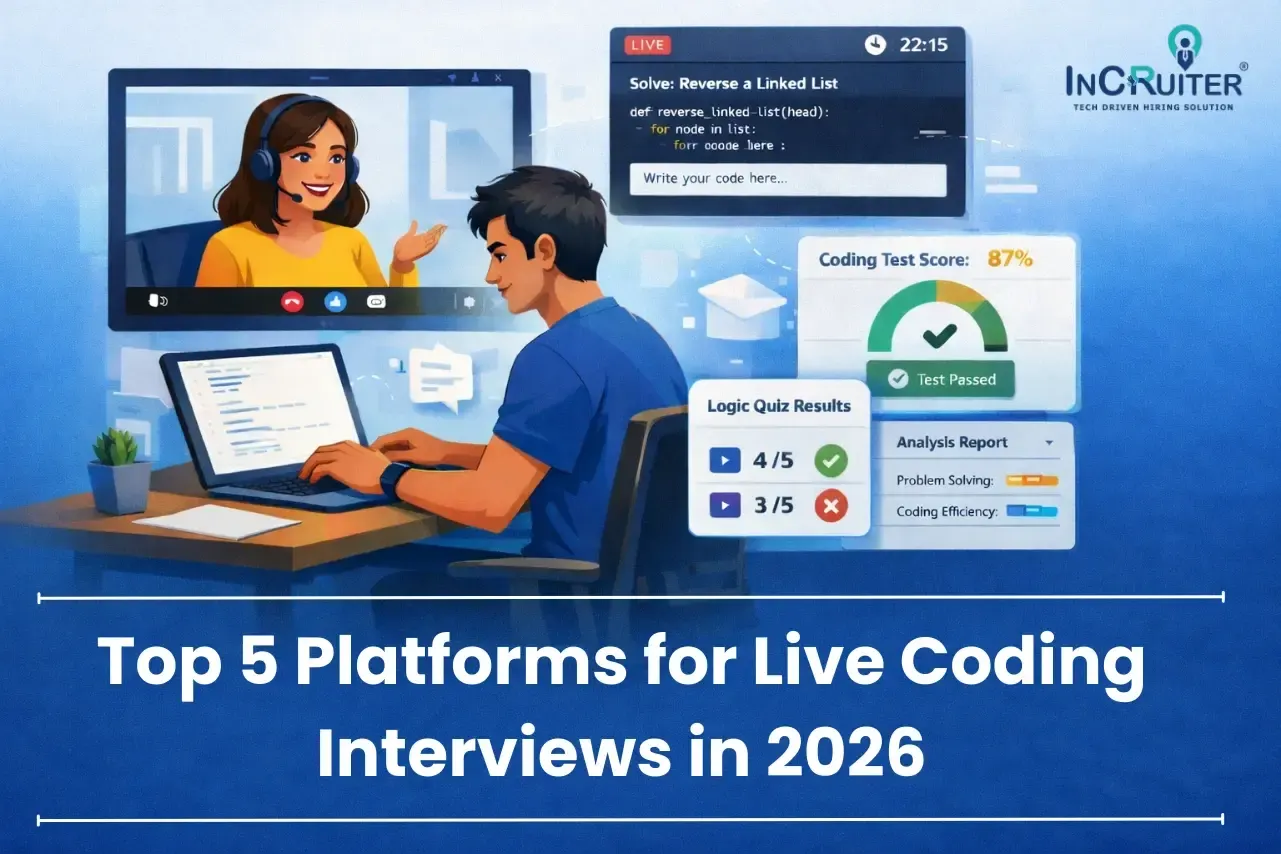
You've just been dropped into a 45-minute live coding session. The timer is running, the interviewer is watching, and the blank editor is staring back at you. You know how to code. You've shipped production features, debugged gnarly race conditions at 2 a.m., and built things people actually use. But your fingers freeze, your mind goes blank, and you spend the first ten minutes in silence, hoping the solution will just materialize.
That silence is what kills most candidates. Not a lack of skill.
By the end of this guide, you'll know exactly what interviewers are scoring you on, how to structure your verbal commentary before you write a single line of code, how to debug out loud without looking lost, and how to prepare for 2026's split landscape of AI-off and AI-on live coding formats. You'll also have a ready-to-use checklist and answers to the most common questions candidates ask right before their session.
What interviewers are actually evaluating (it's not just whether your code compiles)

Companies now conduct 42% more interviews per hire than they did in 2021, averaging 20 touchpoints per position, up from 14 just a few years ago (Gem, 2025). With that many data points to collect, each live coding session has become a structured rubric, not a casual coding hang. 94% of hiring professionals say interviews are very valuable for identifying the best candidates, and technical coding interviews are considered the most valid assessment tool for engineering roles when scored consistently (Criteria Corp, 2025).
Here's what that rubric actually measures:
- Problem-solving approach: Do you decompose the problem logically before touching the keyboard? Do you ask about edge cases and constraints?
- Code quality and structure: Is your code readable, modular, and appropriately commented, or is it a single 80-line function with magic numbers?
- Communication of reasoning: Can you explain why you're choosing a hash map over a nested loop? Can you articulate tradeoffs in real time?
- Time and space complexity analysis: Do you proactively analyze Big-O, or do you wait to be asked?
- Testing behaviors: Do you walk through sample inputs, write basic assertions, or manually trace your logic without prompting?
Four of the five criteria are about communication and process, not just correctness. Even professional engineers at FAANG companies solve LeetCode Medium problems at only a 52.5% success rate during timed practice. The bar isn't "write the optimal solution in ten minutes." It's "demonstrate how you think under pressure."
Your step-by-step preparation framework for 2026
Step 1: Understand which format you're walking into (and ask if you're unsure)
In 2026, live coding interviews fall into three distinct formats, and preparation differs meaningfully across them:
- Traditional DSA interview: LeetCode-style problems on platforms like HackerRank or Codility. AI tools are prohibited. Anthropic, for example, explicitly emails candidates: "Note that use of AI tools during this interview is not permitted." OpenAI, Google, and most established tech firms still require strong DSA foundations as a baseline, even for AI-adjacent roles.
- AI-assisted ("vibe coding") interview: You get access to tools like Claude, GPT-5, or Gemini inside the coding environment and are evaluated on how well you collaborate with AI to reach a correct, well-tested solution. Meta runs a 60-minute CoderPad session with a multi-file codebase and an AI-assist chat window. Roughly 20 to 30% of CoderPad customers now use AI in interviews, and over 35,000 AI-assisted sessions have been logged to date.
- Hybrid format: A traditional DSA round followed by a system design or AI-assisted section. Increasingly common at growth-stage startups.
Before your interview, email your recruiter: "Could you confirm whether AI tools are permitted during the coding session?" This is a professional, expected question in 2026.
Step 2: Build your "think out loud" script template
Silence is the single fastest way to lose points. If your interviewer sees you going down the wrong path, they will redirect you, but only if you're talking. Practice these four verbal checkpoints until they're automatic:
- Restate the problem in your own words (30 seconds): "So if I understand correctly, we're given an array of integers and we need to return the indices of two numbers that sum to a target, and we can assume exactly one solution exists. Does that match your expectation?"
- Surface constraints and edge cases aloud (1 minute): "I want to clarify a few things before I start: Can the array contain duplicates? Can numbers be negative? What's the expected size of the input? Are we worried about O(n²) performance here?"
- Propose your approach before coding (1 to 2 minutes): "My first instinct is a brute-force nested loop: O(n²) time, O(1) space. I can get that working quickly. But if we're okay with O(n) space, I think a hash map approach gets us down to O(n) time. I'll go with the hash map. Sound good?"
- Narrate your implementation (ongoing): "I'm initializing an empty dictionary here to store the complement of each number. As I iterate, I'll check if the current number is already in the dictionary. If it is, I've found my pair."
Step 3: Drill the debug loop, not just the solve
Candidates practice solving problems but rarely practice debugging out loud. Build this four-step verbal debug loop:
- State what you expected: "This should return [0, 1] for input [2, 7, 11, 15] with target 9."
- State what you got: "Instead I'm getting an index error on line 6."
- Form a hypothesis: "I think the issue is that I'm checking
nums[i]before the dictionary is populated on the first pass." - Fix and verify: "I'll move the dictionary update to after the check. Running again, yes, that fixed it. Let me also try a case where the same number appears twice to make sure I'm not reusing an element."
This loop (expected, got, hypothesis, verify) is what senior engineers do instinctively. Doing it out loud in an interview signals exactly that seniority.
Step 4: Practice on realistic platforms, not just static problems
Use platforms that mirror live interview conditions:
- interviewing.io: anonymous mock interviews with real engineers, recorded for self-review
- Pramp: peer-to-peer practice with voice and shared editor
- LeetCode's "Interview Mode": timed, with a blank editor and no hints
- CoderPad: practice in the exact environment many companies use
Target 3 to 4 mock live sessions per week in the four weeks before your interview. Do not do them silently. Record yourself and listen back: are you narrating your reasoning, or just typing?
Step 5: Prepare for the AI-assisted format specifically
If your interview is AI-on, you're being tested on a different skill set. Practice these behaviors:
- Prompt engineering under time pressure: Write a precise prompt before pasting it into the model. "Write a Python function that takes a list of integers and returns the two indices that sum to a given target. Assume exactly one solution. Do not use a brute-force approach."
- Critically evaluate the AI's output: Don't just accept the first response. Say aloud: "The model gave me a hash-map solution. Let me check whether it handles duplicates correctly before I submit it."
- Show ownership of the result: Interviewers in AI-assisted rounds aren't looking for who can use AI the fastest. They're looking for who can be responsible for the correctness and quality of AI-generated code.
Key scenarios broken down: what to say and do
Scenario: You're stuck and the silence is growing
Why this happens: You've hit a dead end and your instinct is to think privately. That silence reads as confusion or disengagement.
What to say instead:
"I'm going to think through this out loud for a second. I know I need to track frequency somehow. A hash map is coming to mind, but I'm not sure yet how to handle the ordering constraint. Let me try sketching the logic before I code it... Actually, if I sort first and use two pointers, that sidesteps the ordering issue entirely. Does that approach make sense to you before I start implementing?"
Why it works: You've shown metacognitive awareness, proposed a pivot, and invited the interviewer into your reasoning. That opens the door for them to hint if you're still off track.
Scenario: You wrote a working but suboptimal solution
Why this happens: You defaulted to brute force and ran out of time to optimize.
What to say:
"This is working for the test cases I've tried: O(n²) time and O(1) space. I know there's likely a more efficient approach. If I had more time, I'd explore whether a sorted input with two pointers or a hash map lookup could get this to O(n). Would you like me to refactor now, or should we move to testing first?"
Why it works: You've demonstrated complexity awareness and prioritization, exactly the behaviors a senior engineer shows when shipping under a deadline.
Scenario: You realize your solution is wrong mid-implementation
Why this happens: You started coding without fully reasoning through the algorithm.
What to say:
"Wait. I just realized my current approach breaks when the array contains negative numbers. My condition on line 4 assumes all values are positive. Let me pause and reconsider the algorithm before I go further down this path."
Why it works: Catching your own bugs mid-implementation is a positive signal, not a negative one. It shows self-review habits and saves you from submitting a fundamentally broken solution.
Mistakes that eliminate candidates
- Starting to code before asking any clarifying questions. Fix: Spend the first 2 to 3 minutes verifying input format, constraints, and edge cases before touching the keyboard.
- Going silent for more than 60 seconds. Fix: If you don't know what to say, narrate your uncertainty. "I'm deciding between two approaches here and I want to make sure I pick the right one."
- Writing the entire solution before testing any of it. Fix: Test your logic on a small example after each logical block, not just at the end.
- Only testing the happy path. Fix: After your main test case, immediately try an empty input, a single-element array, and a case with duplicates or negatives.
- Presenting a brute-force solution without acknowledging its complexity. Fix: Always name the time and space complexity of what you just wrote, even if it's suboptimal, and signal that you know it.
- In AI-assisted formats: copying AI output without reading it. Fix: Read every line of AI-generated code aloud before accepting it. Treat it as a junior engineer's first draft.
- Not asking for help when genuinely stuck. Fix: After three minutes of a true dead end, say "I want to make sure I'm using our time well. Could you give me a nudge in the right direction?" Asking for hints is not a disqualifier; staying silent is.
Immediately actionable prep checklist
Use this in the 72 hours before your interview:
- Confirm with your recruiter whether AI tools are permitted in the coding session
- Review your target company's tech stack and choose your language accordingly (and confirm it's supported on their platform)
- Complete at least two full mock live coding sessions with a partner or on interviewing.io, spoken, not silent
- Practice the four-checkpoint "think out loud" script template until it's automatic
- Drill the four-step debug loop (expected, got, hypothesis, verify) on at least three problems
- Review Big-O analysis for hash maps, trees, sorting algorithms, and graphs. You should be able to state complexity without pausing
- Test your tech setup: stable internet, working microphone, backup internet source, IDE or browser tab pre-opened to the interview platform
- Prepare two clarifying questions you'd realistically ask before coding (constraint-based and edge-case-based)
- Prepare one question for the end of the interview about the team's engineering culture or codebase. This signals genuine interest
- If AI-assisted: practice writing tight, specific prompts and critically reviewing model output on 3 to 5 problems
Frequently asked questions
How long do I have to solve a live coding problem before I should ask for a hint?
Give yourself a genuine attempt, typically 3 to 5 minutes of active problem-solving with narration. If you're still fundamentally stuck after that, asking for a hint is expected and professional. Most interviewers build hint-giving into the session structure. What disqualifies candidates isn't asking for help; it's sitting in silence for ten minutes and then asking.
Does it matter which programming language I use?
In most cases, no. Interviewers care about your reasoning, not your syntax. Python is the most common choice for DSA interviews because it's concise and readable. That said, if the role is in Go or Java, using that language signals fluency and reduces friction. Always use the language you can write most fluently under pressure, and confirm with your recruiter that the platform supports it.
What if I solve the problem but the interviewer asks me to optimize further and I have no idea how?
This is a designed test of your communication under pressure, not a gotcha. Say: "I want to think through this carefully. The current solution is O(n log n) because of the sort. To do better, I'd need to avoid sorting, which makes me think about linear-time approaches like a hash map or counting array. I'm not certain of the exact implementation yet, but that's the direction I'd explore." Showing the right direction of thinking, even without the full answer, often earns partial or full credit on the optimization dimension.
How is a 2026 AI-assisted interview different from a regular live coding session?
The core difference is what you're being evaluated on. In a traditional session, you're evaluated on your ability to write correct, efficient code from memory. In an AI-assisted session, you're evaluated on your ability to collaborate with AI: writing precise prompts, critically reviewing generated output, catching bugs the model introduced, and owning the quality of the final result. The difficulty doesn't decrease. In many cases it increases, because the problem complexity is raised to compensate for AI access.
What's the biggest mindset shift that separates candidates who pass from those who don't?
Treating the interviewer as a collaborator, not an examiner. The candidates who perform best aren't the ones who solve the problem fastest in silence. They're the ones who make the interviewer feel like they're pair-programming with a thoughtful engineer. Ask questions, share your reasoning, invite feedback, and treat hints as normal parts of the conversation. That shift alone changes how the entire session feels, for both you and the person scoring you.
Live coding interviews in 2026 reward a specific, learnable skill: the ability to think visibly. Your code matters, but it's ultimately evidence of the thinking that produces it. Practice narrating that thinking until it's as natural as the coding itself, and you'll walk into your next session not hoping for the right problem, but confident that any problem is one you can work through out loud.
Editor's Picks
 News
News AI Layoffs 2026: Record Profits, Pink Slips & Jobs That Survive
Jul 20, 2026
 Industries
 AI & ML Engineer Jobs 2026: Salaries, Skills & How to Break In
Jul 20, 2026
 Skills
 AI Skills Non-Tech Workers Actually Need to Get Hired in 2026
Jul 20, 2026
 Job Search
 Hidden Job Market 2026: Land Roles Never Posted Online
Jul 20, 2026