STAR Method 2026: Real Examples for Every Job Level
Master the STAR method in 2026 with real example answers for entry-level, mid-career, and senior candidates. Prep smarter and ace your behavioral interview.
You have a behavioral interview in 48 hours. The job posting mentions "strong leadership," "cross-functional collaboration," and "data-driven problem solving." You know the classic advice: use the STAR method. But maybe you've never actually built a polished STAR answer from scratch, or you built one years ago and it now sounds generic. By the end of this guide, you'll have a repeatable framework, level-specific example answers you can steal and adapt, a clear picture of the mistakes that quietly eliminate candidates, and a same-day checklist to walk into any behavioral interview feeling genuinely prepared.
What interviewers are actually evaluating
Behavioral questions aren't small talk dressed up as structure. When a hiring manager says "Tell me about a time you dealt with a difficult stakeholder," they're running a mental checklist that has nothing to do with the specific story you choose. They want evidence of transferable competencies: the behaviors that predict whether you'll succeed in their environment, not just the last one.
Here's what's behind the curtain:
- Predictive validity: Structured behavioral interviews have a predictive validity of .42 for job performance, more than double the .19 of unstructured conversations, according to Sackett et al.'s research replicated as recently as 2025. Interviewers using STAR-based scoring know this. They're not being pedantic about format; they're calibrating against a proven methodology.
- Competency fit: In 2026, the six competency areas that appear most consistently across job levels are leadership, teamwork, problem-solving, communication and conflict, adaptability, and time management. LinkedIn's 2025 Skills on the Rise report ranks adaptability among the top three fastest-growing skills employers look for. Communication sits at number one overall.
- Skills they can't see on a resume: SHRM's 2025 Talent Trends report identifies critical thinking as one of the hardest competencies to assess from a CV alone, so interviewers probe it through situational stories.
- Self-awareness: Do you know what your actual contribution was, versus the team's? Can you separate "we" from "I" when it matters?
- Learning orientation: Did you extract a lesson from setbacks, or do you just recount what happened?
- Conciseness under pressure: 87% of employers use behavioral interviews, partly because they reveal how you think on your feet, not just what you know.
Understanding these criteria changes how you prep. You're not trying to tell a great story. You're trying to produce evidence against a competency rubric.
Your preparation framework: build 8-10 STAR stories before the interview
Don't walk into a behavioral interview hoping you'll remember a relevant example in the moment. The research is clear: candidates who pre-build a bank of 8-10 STAR stories can field almost any behavioral question a recruiter throws at them, because the underlying competencies are predictable even when the exact wording isn't.
Here's how to build that bank, in order:
Map the job description to competencies (Day 1, 20 minutes). Pull every behavioral or skill-related phrase from the posting: "manages ambiguity," "leads cross-functional teams," "drives results." Group them into the six core competency areas: leadership, teamwork, problem-solving, communication/conflict, adaptability, time management. These are your target categories.
Mine your experience for raw material (Day 1, 30 minutes). List your last three to five roles or major projects. For each, brainstorm peak moments: a difficult deadline you hit, a conflict you resolved, a process you improved, a time you failed and recovered. Don't filter yet. Volume first.
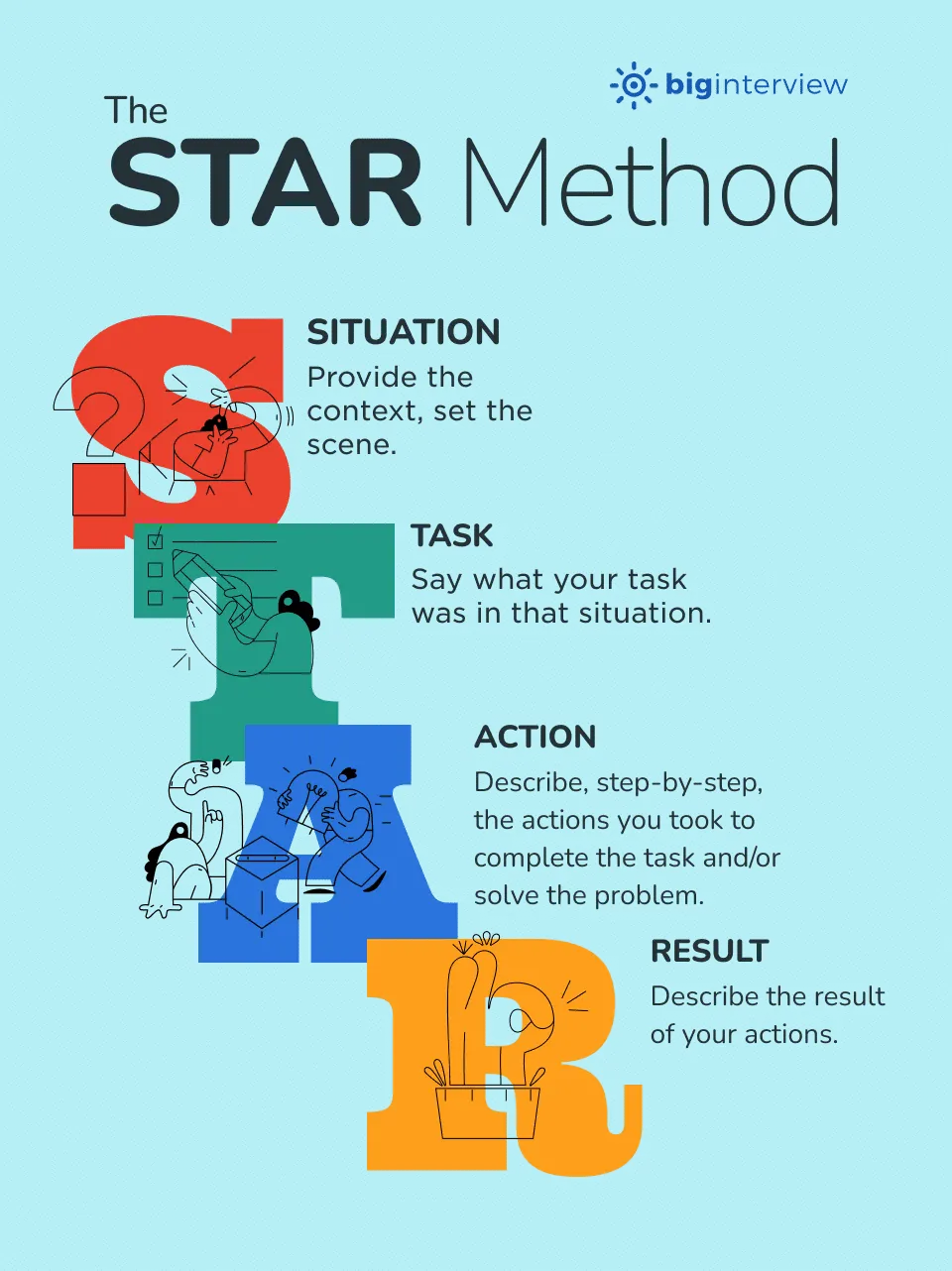
Draft each answer using the 20-10-50-20 rule (Day 1-2). Allocate your answer like this: Situation gets ~20% (2 sentences of context), Task gets ~10% (1 sentence on your specific responsibility), Action gets ~50% (3-4 sentences on exactly what you did, step by step), and Result gets ~20% (what happened, with numbers if possible, plus what you learned). Target: 60-90 seconds per answer out loud.
Quantify at least 60% of your results. Vague results ("things improved") lose to specific results ("reduced onboarding time by 30%"). Dig for percentages, dollar amounts, time saved, NPS scores, headcount managed, or revenue influenced.
Record yourself and audit the ratio (Day 2). The biggest structural mistake candidates make is spending too much time on Situation and Task while rushing through Actions and Results. Play back your recording: if Action doesn't take up roughly half your answer, rebalance it.
Practice one answer per competency category out loud (Day 2-3). Don't just re-read your notes. Speak each answer to a timer, a mirror, or a practice partner. Fluency comes from saying the words, not reading them.
Prepare two versions of your strongest stories. Some interviewers want a 60-second answer; others will probe for 3 minutes. Know how to expand and compress the same story without losing the core evidence.
Question-by-question breakdown with real example answers
The following covers the six highest-frequency behavioral question categories, with a full or partial example answer at three job levels (entry, mid-career, and senior) so you can find your fit and customize from there.
"Tell me about a time you led a project or initiative"
Why it's asked: Interviewers are testing leadership capability. Not just whether you had a title, but whether you drove outcomes, aligned people, and handled friction. This question appears at every level; the scope of the story should scale with seniority.
Entry-level example:
"During my final semester, our four-person capstone team was two weeks behind schedule because one member had a family emergency and another had conflicting course deadlines. As the de facto project lead, I reorganized the workload by mapping each person's remaining bandwidth in a shared doc, reassigned the heaviest sections to the two of us who had more capacity, and set up 20-minute daily check-ins to catch blockers early. We submitted on time and received an A. More importantly, I learned that early workload visibility prevents the last-minute scramble. I've built that habit into every group project since."
Mid-career example:
"At my last company, I led the rollout of a new CRM platform for a 40-person sales team on a 10-week timeline. The biggest risk was adoption. Our team had rejected a tool change two years prior. I ran three stakeholder interviews before launch to identify the specific pain points people feared most, then worked with the vendor to configure two features that directly addressed them. I also trained eight internal champions who became peer coaches. Adoption hit 85% in week four, ahead of the 90-day target, and pipeline data accuracy improved by 22% in the first quarter."
Senior-level example:
"As VP of Operations, I sponsored a $2.4M supply chain consolidation project that touched five business units and three countries. The initial project charter had no formal governance structure, which had caused two prior initiatives to stall. I established a weekly steering committee with one decision-maker from each region, defined an escalation protocol with 48-hour resolution SLAs, and embedded a risk register reviewed at every meeting. We delivered in 11 months against a 14-month estimate, captured $610K in annualized savings, and the governance model was adopted as the company standard for cross-border projects."
Customization note: Swap the domain (capstone to internship, CRM to ERP, supply chain to product launch) and keep the structural logic identical. What matters is that your Action block shows specific steps, not just "I organized the team."
"Describe a time you dealt with a difficult coworker or stakeholder"
Why it's asked: Interviewers are evaluating communication, emotional intelligence, and conflict resolution, all in one. They want to know whether you escalate immediately, avoid conflict entirely, or work through friction productively.
Mid-career example:
"A senior engineer on a cross-functional project consistently pushed back on my team's timelines in public Slack channels, which was creating tension and slowing decisions. Instead of responding in the channel, I requested a 30-minute one-on-one call and asked open-ended questions about what was driving his concern. It turned out he had context about a technical dependency that hadn't been shared with my team. I incorporated his input into a revised timeline, credited him publicly in the next team meeting, and set up a bi-weekly sync so his team had a standing channel to flag technical risks early. The project shipped on the revised date with no further public disputes."
Customization note: This question probes how you engage, not whether you "won." Show the step where you sought to understand before reacting. That's the behavior interviewers score highest.
"Tell me about a time you failed or made a significant mistake"
Why it's asked: This is a learning-orientation test. Interviewers want to see whether you can acknowledge accountability without being defensive, and whether you extracted a durable lesson.
Entry-level / career-changer example:
"In my first role managing social media for a nonprofit, I published a fundraising post before it had been approved by the communications director. It went live during a sensitive period related to an organizational announcement we hadn't made yet. I caught it within 20 minutes and immediately notified the director, who had me take it down and draft a brief internal memo explaining what happened. I put a personal approval-confirmation step, a literal checklist, at the top of my content calendar from that day on. In the eight months after, zero posts went out without sign-off. The director mentioned my accountability and follow-through in my performance review."
Customization note: The instinct is to pick a "fake" failure that's really a humble-brag ("I work too hard"). Resist it. Interviewers have heard that answer thousands of times. A real, contained failure with a genuine lesson and a concrete fix is far more compelling.
"Give me an example of adapting to a major change at work"
Why it's asked: LinkedIn's 2025 Skills on the Rise report ranks adaptability among the top three skills employers are actively prioritizing. Expect this question in any environment that has gone through restructuring, remote/hybrid shifts, or rapid growth.
Mid-career example:
"Six weeks into a new role, my company announced a restructuring that eliminated my direct manager's position and merged two teams. Overnight, my project priorities changed and I was reporting to someone who didn't yet know my work. I scheduled a 45-minute alignment meeting with the new manager in the first week, came in with a one-pager summarizing my current projects, their status, and the decisions I needed from her within 30 days. I also volunteered to document the merged team's workflows since I was newer and had fresh eyes. The manager later told me that document became the baseline for the team's onboarding guide. I was promoted into a senior role six months later."
"Tell me about a time you used data to solve a problem or make a decision"
Why it's asked: As data literacy has become a baseline expectation across functions, interviewers use this question to separate candidates who reference data casually from those who actually use it to drive decisions.
Senior-level example:
"Our customer support team had a rising ticket volume, but satisfaction scores were holding steady, so leadership didn't see urgency. I pulled 90 days of ticket data, segmented by issue type and resolution time, and found that one product category accounted for 38% of volume but only 9% of first-contact resolution, meaning those customers almost always had to call back. I built a two-slide business case showing the cost per repeat contact versus the cost of a targeted FAQ and an agent training module. Leadership approved the fix in three weeks. Repeat contacts in that category dropped 41% in the following quarter, freeing up roughly 200 agent-hours per month."
"Describe a time you managed competing priorities or a tight deadline"
Why it's asked: Time management is one of the six core competency areas and surfaces in nearly every role. Interviewers want to see a system, not just "I worked harder."
Entry-level example:
"During exam week, I was also finishing a 20-hour-a-week internship with a project deadline that overlapped with two finals. On Sunday evening, I listed every deliverable (internship and academic) by due date and estimated hours. I identified that my internship project could be broken into three independent modules and completed the two that were furthest from my coursework on Monday and Tuesday mornings, before my focus shifted to studying. I was transparent with my internship supervisor on Monday about my timeline, and she approved a 48-hour extension on the third module. I submitted all three and passed both exams. The habit of front-loading my workload by urgency and dependency has stayed with me since."
Mistakes that eliminate candidates
These are the errors that don't feel like mistakes in the moment, which is exactly why they're dangerous.
- Spending more than 30% of the answer on Situation and Task. Fix: time yourself; if setup exceeds 30 seconds, cut it in half.
- Saying "we" throughout the Action section. Fix: explicitly name what you personally did, then acknowledge the team in the Result.
- Delivering a vague result ("things improved," "the team was happy"). Fix: tie every result to at least one number, even a rough one ("roughly 20% faster," "saved about six hours a week").
- Choosing a story that's too old or too irrelevant. Fix: aim for the past 2-3 years whenever possible; if you must go older, bridge it ("that experience directly shaped how I approach X today").
- Memorizing a script instead of internalizing the structure. Fix: practice speaking from bullet points, not from a written paragraph. Rigid scripts fall apart under follow-up questions.
- Skipping the learning or reflection beat in failure questions. Fix: always close a negative story with a concrete behavior change you made afterward.
- Using hypothetical language ("I would...") instead of past tense. Fix: every STAR answer must describe something that actually happened. If you catch yourself drifting into "would," stop and reframe.
Pre-interview STAR prep checklist
Use this the day before or morning of your interview:
- Identified the 6-8 core competencies in the job description
- Built at least one STAR story per competency category
- Each story has a result with at least one specific number or metric
- Recorded myself delivering each answer and confirmed Action takes ~50% of the time
- Prepared both a 60-second and a 2-minute version of my top three stories
- Removed all "we did" language from the Action sections
- Prepared a "failure" story with a genuine lesson and a concrete fix
- Confirmed all stories are from the past 2-3 years (or bridged to the present)
- Reviewed the company's values or leadership principles for story alignment (Amazon Leadership Principles, McKinsey problem-solving style, etc.)
- Practiced at least two full answers out loud with a timer today
FAQ
How long should a STAR answer be? Target 60-90 seconds for most behavioral questions. Some interviewers will stop you at 90 seconds; others will let you run to 3 minutes and probe with follow-ups. Build a 90-second core answer and know which details you'd add if given more time.
Can I use the same STAR story for more than one question? Yes, but reframe the emphasis. A single project can produce a leadership story, a conflict story, and a data-driven decision story, as long as you shift which Actions you highlight in each. Just don't use the identical answer verbatim for two questions in the same interview.
What if I don't have a relevant work example because I'm a recent graduate or career changer? Behavioral answers don't have to come from paid jobs. Academic projects, internships, volunteer leadership, freelance work, and even significant personal challenges (organizing a major event, managing a family business situation) are all valid, as long as the competency you're demonstrating is genuinely transferable. Be explicit about the bridge: "This was in a university context, but the stakeholder dynamics were identical to what I'd face in this role."
Should I mention the company or team name in my STAR answer? You can mention your own company or team if it adds context, but avoid confidential details like client names, proprietary revenue figures, or internal system names that could create legal or NDA issues. Approximate numbers ("a Fortune 500 retailer" or "a team of roughly 20 people") are fine and often cleaner.
What's the difference between STAR and SOAR? SOAR (Situation, Obstacle, Action, Result) is a variant that replaces "Task" with "Obstacle" to foreground the challenge more explicitly. It works well for roles where problem-solving under adversity is the central competency: consulting, operations, crisis management. STAR remains the more widely recognized format and is the safer default unless you're tailoring specifically to a consulting or turnaround-focused role.
The STAR method has been shaping hiring decisions since DDI introduced it with Targeted Selection in 1974, and it still works in 2026 because structured behavioral evidence genuinely predicts performance. The candidates who get offers aren't always the most experienced in the room; they're the ones who can surface the right evidence, in the right structure, at the right moment. Build your eight to ten stories this week. Quantify every result you can. Practice out loud. Then walk into that interview knowing you're not hoping you'll remember something relevant. You've already prepared for almost anything they can ask.
Editor's Picks
 News
News AI Layoffs 2026: Record Profits, Pink Slips & Jobs That Survive
Jul 20, 2026
 Industries
 AI & ML Engineer Jobs 2026: Salaries, Skills & How to Break In
Jul 20, 2026
 Skills
 AI Skills Non-Tech Workers Actually Need to Get Hired in 2026
Jul 20, 2026
 Job Search
 Hidden Job Market 2026: Land Roles Never Posted Online
Jul 20, 2026